Sunday, February 12, 2012

A Madhouse In The Quarter: A STREETCAR NAMED DESIRE

Elia Kazan's A Streetcar Named Desire, reminds me of Lewis Carroll's Alice falling into the rabbit hole.

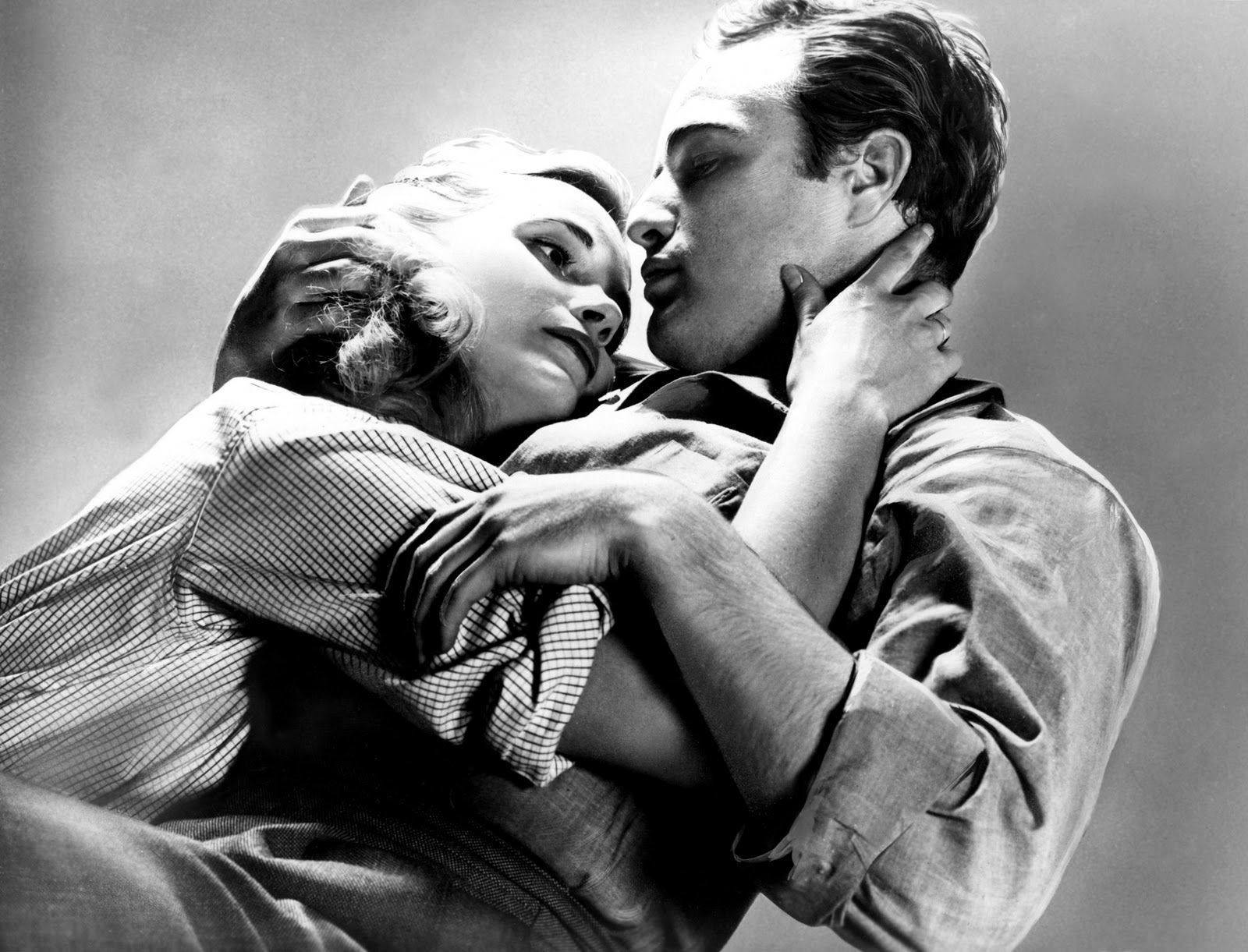
Tennessee Williams wrote his Pulitzer Prize winning play "A Streetcar Named Desire" in 1947. The play centers around the lives of four people: Blanche Du Bois (originally acted on stage by Jessica Tandy), Stanley Kowalski (originally acted on stage by a relatively unknown Marlon Brando), Stella Kowalski (originally acted on stage by Kim Hunter) and Mitch (originally acted on stage by Karl Madden). The play is set in the seedy strip of the French Quarter in New Orleans. The claustrophobic heat in the air of New Orleans lends itself perfectly to characters on the verge of boiling over and losing everything. Williams play opened to a shocked but fascinated audience. The plays themes of alienation, disorientation, redemption, loss, emotional and physical abuse, and mental illness pushed the boundaries of mainstream theater written during the 1940s.  "A Streetcar Named Desire" was immediately hailed by critics as a boundary breaking masterpiece; a play for which Williams won the 1948 Pulitzer Prize for Drama. Just a few short years later, Williams approached Elia Kazan (who had directed the first US Theater production of Streetcar on Broadway) to adapt his play for the screen. Kazan initially objected to turning the already beloved play into a film but eventually, with the support of Williams, they adapted the story together. The film would go on to cast nine of the original cast members playing the same roles they performed on stage, including Brando, Hunter, Malden. The only change was the part of Blanche. Vivien Leigh was offered the part over Jessica Tandy, due to Leigh's rising star power. Ironically, Vivien later suffered from bi-polar disorder, much like Blanche in the film, and her mental instability would only enhance her performance of the fading and disturbed southern belle.

Because of the enforcement of the Hays Code, the film had to change two major plot points for film audiences. Blanche, citing the reason for her late husband's suicide as a general weakness, helped to imply that he was a homosexual, which at the time the film was made was not directly implicated onscreen. This narrative point helps to further understand Blanche and her compulsive need for male attention to survive. Clearly her husband's sexuality and eventual self inflicted death would've directly influenced her feeling of inadequacy and sexual impotence. This is one of the main reasons Blanche suffers a break from reality and begins to deteriorate mentally. The film deals with this "loss of content" rather eloquently, and even though the sexuality of her late husband is never directly referred to in the film, the viewer understands Blanche's feelings of loss  and its impact on her mental faculties.

The second stipulation of the code was the change in the ending of the film. In the play, Stanley rapes Blanche and severs her last fragile tie to reality, plummeting her into the darkness of insanity. Even though the rape occurs in the film (although it occurs offscreen), the ending in the play and the film dramatically differ. Stanley is a brute, a man fueled by his desire. His relationship with his wife Stella is built on a sexual hunger and rests in the comfort of her willingness to stay with him, despite the violence.  The play ends with the violent rape of Stella's sister. Stanley races to find Stella and the play ends with them wrapped in a embrace; Stanley on his knees grasping for Stella's breast. Stella stays. The ending of the film ends on a completely different note and tone. The code was implicit in it's insistence on punishing the rapist. So the end of the film ends with rape and Stanley frantically searching for Stella, only she (grasping onto her newborn child) runs away from his embrace and the film ends with Stanley's cries echoing through the quarter.

Kazan was insistant on using space to create a visual representation of Blanche's mental deterioration. His art director, Richard Day, along with the set designer, George Tompkins, create a space they reduced in size as the film progressed. The Kowalski apartment becomes smaller and contained the more that Blanche becomes consumed by the claustrophobic space inside her head. The space surrounding her is visually contracted to exhibit her mental state. This is a feat of production design and helps the viewer feel a sense of the agony that Blanche is struggling to breathe through. The film is masterfully shot in black and white, and captures through shadow and space, the violence that is constantly at bay lurking in the depth of each of these characters. Blanche, towards the final climax of the film, pronounces to her potential lover, "I don't want realism, I want magic. Yes, yes magic. I try to give that to people. I do misrepresent things. I don't tell truths.  I tell what ought to be true". This provides the moral of this story, Blanche would rather live her life in the shadows of her fantasies, because only within her mind, is she desired, beloved and held above all others. Reality only offers crushing disappointment and pain. She retreats into the recesses of her mind and creates a world without pain, and when given the choice, she would stay there forever.

 Opening Tiles

 Stanley at the table, lost inside his own head.

 The undefinable Marlon Brando as Stanley

 After one of Stanley's violent moments, clinging to Stella, the woman he loves.
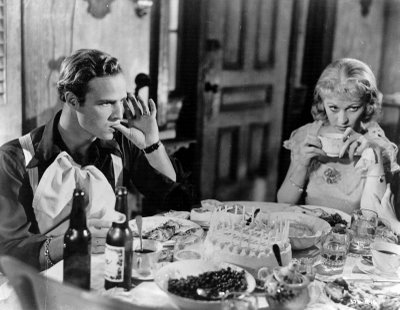
 Stanley exhibiting his anger and Blanche her poise

 The real Streetcar named Desire in New Orleans

 Stella begins to realize her sister is not herself

 The unforgettable Vivien Leigh as Blanche

Stanley, going through Blanche's things, he is intent on hating her. 

Thursday, February 9, 2012

Guest Blog: THE MAN WHO SHOT LIBERTY VALANCE: a love triangle, old west style.

I finished another guest blog for http://allowmetoretort.blogspot.com/. Check it out below. 

INFO:
TITLE: "The Man Who Shot Liberty Valance"
YEAR OF RELEASE: 1962
DIRECTOR: John Ford
STARS: Jimmy Stewart, John “The Duke” Wayne, Vera Miles, Lee Marvin
EDITOR: Otho Lovering
AWARDS: Edith Head was nominated for an Academy Award for Best Costume Design in 1963. This film was also selected in 2007 to be inducted into the National Film Registry.
BOX OFFICE: $8,000,000 (USA)
RUN TIME: 123 min.
RATING: 
VIEWING FORMAT: Netflix Steaming

SUMMARY:
A senator, who became infamous for the killing of a notorious outlaw, returns home for the funeral of his friend and finds himself telling the truth about the events of that long remembered night. 

WHY THIS IS THE FILM OF THE WEEK:
The four-time academy award-winning director John Ford was at the helm of The Man Who Shot Liberty Valance. Ford’s westerns help shape what the boundaries of the cinematic west and this film has become one of the most beloved westerns of all time.

The film also brings together two of the most talented actors of their time, John “The Duke” Wayne and Jimmy Stewart.  James Warner Bellah and Will Goldbeck’s screenplay allows these two amazing actors to battle with words, not bullets. The verbal sparing that takes place throughout the film makes it impossible to tear your eyes from the screen.


CRITIQUE:
Ford’s exacting use of space illustrates the abandonment and isolation of the American West. His characters have to learn to create a system of justice within the small constraints of Main St. The Man Who Shot Liberty Valance depicts the nature of small town politics and the justification of rights and liberties for all men, regardless of their station and creed.

Jimmy Stewart plays Ransom Stoddard, the man full of heart and inspired by injustice, that sets forth to change the dynamics of the town and rid its citizens of their notorious outlaw, who had been causing death and destruction for as long as they could remember.  Stoddard sets out to bring Valance to justice with books not fists; he wants to change the laws of the land with words.

But Stoddard must also stand up against the town’s protector, Tom Doniphon (played to perfection by John Wayne) a hard-edged cowboy with the fastest draw in the west. Doniphon is only out to protect the girl in town with who he is in love with. Hallie, played by Vera Miles, finds herself torn between Ransom and Tom. Both men find themselves entwined in the political nature of the changing times and the emotional upheaval caused by their hearts. This is what keeps this film interesting from beginning to end.

Ford creates a stage for his characters, taking each actor to their limits and creates a beautiful dialogue between the old and new west to find a solid ground underneath. Its amazing ensemble cast expertly portrays the tensions in the film and the verbal battles that occur between Stoddard and Doniphon keep the viewer immersed in the action onscreen.

This is a must see for any Western aficionados and for any film geeks interested in expanding their cinematic vocabulary.


MY IMDb RATING:  9 out of 10


Wednesday, January 25, 2012

Guest Blog: ON THE WATERFRONT: Survival against all odds

My review for ON THE WATERFRONT, which I guest blogged on http://allowmetoretort.blogspot.com/

BASIC INFO:
TITLE: On The Waterfront 
YEAR OF RELEASE: 1981
DIRECTOR: Elia Kazan
STARS: Marlon Brando, Karl Madden, Lee J. Cobb and introducing Eva Marie Saint
EDITOR: Gene Milford
AWARDS: Won 8 Academy Awards: Most Notably for Best Actor in a Leading Role, Best Actress in a Supporting Role, Best Director, best Film Editing, Best Screenplay, Best Cinematography and Best Art Direction
BOX OFFICE: $910,000
RUN TIME: 108 min.
RATING: N/A
VIEWING FORMAT: Netflix Streaming

SUMMARY: 
Tony Malloy, an ex-prize fighting boxer, becomes a longshoreman who has family ties to the mob wh controls the waterfront. When Terry is involved in the murder of an innocent man, he stuggles to break free of the corruption controlling the docks while leading other to follow his cause.

WHY THIS IS THE FILM OF THE WEEK:
On The Waterfront is one of the most critically acclaimed movie in the history of cinema. It was nominated for 12 Academy Awards in 1955, winning 8. It consistently ranks in the top 100 of all major film lists.

This film remains universally relevant and the themes of injustice, plight of the common man, and the struggle for freedom remain key themes in cinema today. This film resonated with everyone who watches it and I believe is the reason for its timelessness.

CRITIQUE: 
Kazan's tale of class struggle remains as relevant today as it did in 1955. Brando has been forever remmebered for his portrayal of Terry Malloy, a young man trapped with a system of unfairness beyond his means of control. When Terry is involed in the death of an honest man who tried to stand up to the mob, he begins to struggle within himself to find a way out. He cbecomes romantically involved with the victim's sister Edie, Eva Marie Saint, and together, with the town priest, decide to stand up against the corrupted mob controlling the waterfront.

This film is beautifully arranged in both its words and images. The stark black and white cinematography seeks to articulate the plight of the common man versus the indulgence of the mob bosses who seek to live their lives without consequences.

The acting performances in this film are what helps it to shine. I found the conflicted nature of Brando's nuanced performance both impassioned for his plight and apathetic to his circumstance. It is only with the insistent solidarity created by the community, that Terry is able to stand up agains the mob that tired desperately to contain him.

Kazan's fim will always remain of cornerstone of cinema, not only for its artistic merit but for its examination of struggle and captivity of industry that we still feel in this country today. 


Thursday, January 12, 2012

Life Among The Ruins: IN THE LAND OF BLOOD AND HONEY

Refugee comes from the french word refugier, which literally means to take shelter. Shelter is hard to come by in the new film by Angelina Jolie, her debut effort as a director. This film explores the nature of becoming a refugee in your own homeland, being forced to flee for safety while watching friends turn into murderous foes.

Angelina's film begins with an image of Sarajevo from above, she allows us access to her characters world from a perched view, watching the landscape create a narrative of it's own. While we get settled inside the screen, into the lush landscape, we are pulled into her created reality by the words that appear on the screen. Jolie explains that the Republic of Bosnia-Herzegovina was home to some of the most ethnically diverse populations that ever co-existed. Croatians, Serbians, Muslims and Yugoslavs all shared this land, spoke the same language, and embraced cultural differences. In 1980, when the Communist Leader of Yugoslavia, Marshall Josip Broz Tito, died the Serbians began to witness the simultaneous collapse of Communist governments across Eastern Europe. This collapse bolstered the Serbian nationalist movement to seek power across the Republic while splintering Yugoslavia's other republics to assert their independence.

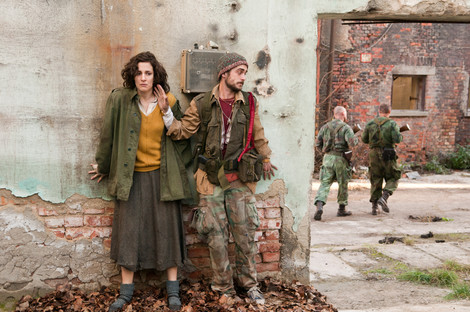
The film explores the early origins of the conflict and it's ultimate descent into madness. We first met Ajla (Zana Marjanoić) standing in front of a painting, a face. She shares her small apartment in Sarajevo with her sister, Lejla (Vanesa Glodio) and newborn baby. We learn that Ajla has come back to Bosnia to help her sister care for the little one. The moment of calm and happiness erupts in the next scene when Ajla mets her lover, Danijel (Gornan Kostić), at the neighborhood bar. One minute they are dancing and whispering sweet nothings we never hear and, the next, a bomb explodes and the entire building collapses into smoke. The screen shuts to black and all we hear are the sounds of terror. This is what we are left with before the world falls a part.

Several months later, bombs alert a sleeping Ajla and Lejla to the onslaught of terror that has yet to grace their doorstep. The next morning, their apartment building is taken over by the Serbian Army. Everyone is immediately evacuated, forced to be paraded outside in the freezing weather. The men and boys are scrambled together and are forced to the side of the apartment building, Jolie doesn't allow us access to their slaughter but instead lets us witness the trauma on the faces of their widows left behind. The soliders then precede to pick out some of the younger women from the crowd left standing, pushing them all towards a van, the destination unknown, while the others stand aside to watch. Ajla is selected and the separation from her sister begins the first of many political, physical and emotional schisms throughout this film.

The horror that enfolds in the center section of Jolie's film is not for the fient of heart. Most of the story follows Ajla in a Serbian Army camp, where the women are used as sexual toys and house maids. They live in constant fear of repetitious rape and several of the women speak of their wish to die rather than endure the mental and physical deterioration. Jolie is very retrained in her cinematic license and mostly chooses to use sound and dialogue as vehicles for experiencing pain. One scene in particular stood out to me, mostly because of the subtlety of action. The scene takes place in the middle of the night, the camera sits to the right of Ajla, wide awake and shaking. From behind her, she hears a solider enter their sleeping quarters as he takes one of the women out of her bed and carries her away. The only sounds are Ajla breathing, the man's boots, and the woman struggling in the background. Jolie, refrains from calling melodrama to the moment of sheer terror, instead allowing us to be a silent witness along with her protagonist.

This film follows the four year conflict in it's entirety. Jolie sets out to explore the nature of war on all kinds of relationships; between lovers, friends, relatives, and strangers. Over the course of the conflict, over 100,000 people were killed, over 2 million were displaced from their homes, and between 20,000 and 50,000 women were raped, mostly while being held in captivity. Over four years, over 360 shells were fired every day and citizens became caged in their own homes with fear of sniper fire outside the walls of safety.  It was after the Bosnian conflict that the UN officially ruled that raped was a crime against humanity, on it's own accord. Jolie wants these issues to forefront her film. She wants her audience to leave the theater having learned something, She forces, repeatedly , the issues of international amnesia and insists that all conflicts that involve violations of human rights are international crises. She insists that we must sit up and pay attention. This is a tall order but is something that haunts every corner of her film; in television sets, newspapers, and radio reports which litter the background.

Zana Marjanoić, is stunning as Ajla. Her journey through this film is something that astounded me. I don't want to illuminate on the plot of the film, as I think the audience needs to experience it for themselves. Jolie's command of space and the world in which her characters inhabit is something that should be praised. She brings to life a beautiful story of love, loss, depravity, and the silver lining that sustained hope provides. This film demands to be seen.


 Ajla at the window, she spends much of her time in the camp looking out her window

 Hearing the men in the courtyard below allows her outside access through her window

 Danjiel and Ajla, the first time they meet again in the camp

 Jolie at the helm

 Ajla and Lejla watches the soliders coming into town 

 The lovers remain separated by differences but secretly long to be together

 A firing squad 

 The world the captured women inhabit at the Army Camp

 Using the women as shields in a fight against the resistance


 Trying to escape

Jolie at the helm

Body Horror: THE SKIN I LIVE IN

This weekend I attended an Almodóvar double feature at the New Beverly, first up was his new psychological horror film entitled THE SKIN I LIVE IN (2011), followed by his last release BROKEN EMBRACES (2009).

I really wanted to put together a blog post on THE SKIN I LIVE IN but couldn't find the words to write about the film without giving away any details of the plot, which I ardently believe you need to see to believe. So I am sending you to the New York Times review of this film, written by Manohola Dargis, who eloquently describes the interworking of this film without spoiling its intricate plot.

http://movies.nytimes.com/2011/10/14/movies/the-skin-i-live-in-directed-by-pedro-almodovar-review.html?ref=movies

This film is exquisitely pieced together with the artful touch of a master director. Everything about this film breathes new life into a genre built on pornographic slaying. Banderas and Almodóvar create a twisted fantasy world for Robert Ledgard to live and obsess in perfect isolation. Elena Anaya, who masterfully designed her character Vera, will leave you breathless by the film's end.


Feel Something: BEGINNERS

Beginners, a film by writer/director Mike Mills, tells the real life story of his father, a man that was married to the same woman for over forty years and shortly after her death, came out at the age of 75. He was only out for five short years (shortly after coming out he was diagnosed with terminal lung cancer) but instantly grabbed ahold of his unclaimed years and voraciously became the man he always wanted to be. 


Beginners stars Ewan McGregor as Oliver, Christopher Plummer as Hal, Cosmo the dog as Arthur, Mélanie Laurent as Anna, Goran Visnjic as Andy and Mary Page Keller as Georgia . This film is a singular portrait of an ensemble, which I know sounds counter intuitive, but each carefully created personality follows its own path in this film. Each character learns what it means to be comfortable in their own skin and a story that is essential about the experience of one man becomes something universal, it becomes a story we can all tell. 


Mills creates a kaleidoscope of images, words, drawings, and feelings to tell a deeply personal story of the life of his father without bringing his own sentimentality to the table. Hal, a fictional realization of Mills father, truly understands that life culminates in finding out who we are and embracing every aspect of its unexpected twists and turns. The narrative intertwines multiple spaces in time, both before and after the death of Hal. Olivier and his father's dog, Arthur, are the only two characters that inhabit both spaces, allowing the audience a narrative guide through the film. Olivier seems lost in his world, living in an blank space, free from interaction and mistakes. Next to the vibrant image of Hal and the shy yet hungry for experience Anna, Olivier feels outside the narrative space. He seems to move through the film like an observer until he is forced to bloom. The experiences Olivier shares with his father in the last few years of his life inspire something fierce in Olivier's bland existence. His father's relentless search for happiness and love is the launching pad for Oliver's encounter with Anna. 


Anna and Olivier's love story is the perfect mirror to Hal and Andy, whose love transcends traditional boundaries and limitations. Hal and Andy embody an imperfect yet forgiving and tender love that blooms despite life's harsh realities, cancer and imminent death. They fall in love precisely because their love is a love worth taking a leap for. Having been the insider in Hal's life, Olivier utilizes his father's courage to venture down an unknown and formerly hard path to love. Anna is both a believer in magic and the intangible and yet, like Olivier, is tied firmly to the sad reality of empty hotel rooms and lost families. She and Olivier find a way to embrace their new relationship and learn to weather their own storms. 


Although, Beginners doesn't offer a recipe for living, it does encourage the audience to embrace the unknown, to wake up everyday and remember why we are living. This film asks that you FEEL, and feel it, anything and everything, with a childish enthusiasm. We are all Beginners, at life, at love, at death, at living. This film's simple request is that we find comfort in that. 


 Olivier and Hal having a heart to heart at the dog park
 The beginnings of Anna's falling for Olivier
 Walking through Eylsian Park in Los Angeles
 Escapades in the Biltmore Hotel suite that serves as Anna's home
Arthur and Olivier, seeking some companionship


There is also an amazing array of videos, clips, and the trailer for the film on the Focus Features website. Mike Mills also has a blog link on that same site. http://www.focusfeatures.com/focusfeatures/film/beginners/


Tuesday, December 13, 2011

Creating cages of our own devices: SHAME

Shame is a feeling that arises from the consciousness or exposure to unworthy or indecent conduct or circumstances. Steve McQueen's new film Shame peels apart the layers of meaning behind this multi-faceted word and leaves his characters to find themselves amongst the ruins. McQueen directs Michael Fassbinder (Brandon) and Carey Mulligan (Sissy) as a brother and sister who are seeking to find solace in a chaotic and unrelenting space.

The film begins with Brandon, naked in bed. We see him laying with the sheet up to his navel, staring off into space, music swells the screen. He refuses to look at us, or even in our general direction. Brandon is not someone that McQueen is going to let us get close to. Brandon's apartment is a square, white space. We walk the entire length of the apartment with Brandon; from bedroom, to living room, to bathroom, fully nude, somewhat at peace, uninhibited in this sterile place. Brandon's world is constructed out of clean lines, there are no distractions here, nothing to excite the senses, this is a world in which Brandon's addiction can be released. Brandon is an addict, a slave to his body, perpetually fixed on getting off. McQueen never illuminates the cause or circumstances that lead Brandon to this place of alienation, of self-abuse, but we are allowed to see his deterioration, mostly without judgement because we are left out of his past. Brandon's daily routine is infallible; masturbate at home, watch porn at the office, masturbate in the bathroom at work, call a prostitute when he gets home, or watch porn till he falls asleep. Sex propels his day, he is bound by his innate and often unexplained urges. 

His world, and the viewers, is turned upside down when Brandon's sister Sissy shows up unexpectedly in Brandon's apartment. Sissy is the alter ego of Brandon; chaotic, impulsive, overly emotional. McQueen counterbalances Brandon's world through Sissy. She is also pained, chained to her sensitivity, a similar victim of circumstance. They have several exchanges throughout the film, which I believe make this movie nothing short of special. Their interactions are heated, filled with confusion, anger, resentment, and an intense need for emotional connections. This pair of actors are the reason this fim exceeds beyond a simple exploitative film about the cage of sexual addiction and depression. Without Brandon and Sissy, this film is just porn, just a meditation on the breaking of flesh for carnage and self abusive needs. But with them, it surpasses the need for pleasure and breaks into a world of pain. The sex in this film is obtrusive, violent, at times the viewer feels the needs to look away from the screen, but through Sissy and Brandon the sex transcends the physical to become a representation of pain and suffering. These characters are locked in its embrace and are slowly churned into oblivion. 

Fassbinder is fearless and naked (physically but more importantly emotionally) in this performance, allowing himself to be the instrument for his director's art. He brings Brandon's story to life and although we may not understand why he is the way he is or sympathize with his affliction, we care till the very end. Mulligan takes no prisoners in this film, she is uncompromising and doesn't ever plead the audience for their sympathy, though she may require it from Brandon.  The siblings relationship is the heart of this film and honestly I wish McQueen could have found more areas to explore with them. The only fault of this film was it's insistence on pushing the envelope with it's NC-17 rating, giving the audience more flesh than we required and leaving us a bit high and drive on the emotional connections, but Shame doesn't ask more from it's audience than to open our eyes and drink in what we see.


Brandon and Sissy before a moment of explosion. 

 Brandon in his devoid white world. 

 A victim of his fate. 


Brandon's most intimate interaction that fizzles into impotence. 


Brandon, in his empty space, watching porn. 


Sissy's heartbreaking performance of "New York, New York". 


The pain is palpable. Mulligan is astonishing.